AI, honestly
What AI should and should not do in project management
A short, opinionated line between useful and dangerous.
4 min read
Every project tool now has AI in it. Most of the claims are indistinguishable from each other, and a good number describe things nobody should want.
Here is a line that has held up in practice.
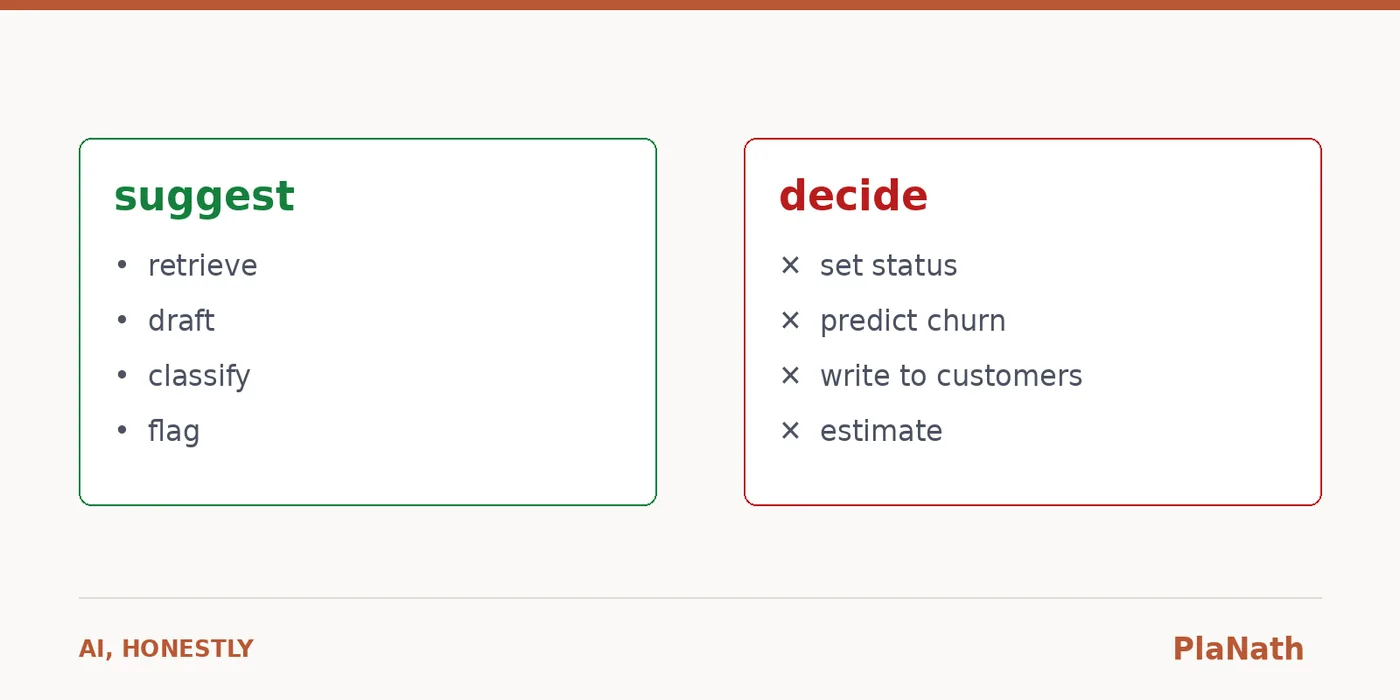
What AI is good at here
Retrieval across scattered records. "What did we agree with this customer about the migration window?" is a question a language model answers well when it can read the escalations, tickets and project notes. This saves real time and the failure mode is mild: if it misses something, you search manually, as you would have anyway.
Drafting from material that exists. A status summary from a week's updates. A first draft of a knowledge base article from a resolution note. A QBR narrative from the quarter's record. The human edits. The value is the blank page disappearing, which is worth more than it sounds.
Classification suggestions. Proposing a category for an escalation at close, which a person confirms. Consistent classification is exactly the kind of tedious work people skip under pressure.
Noticing anomalies for a human to check. "This task has not changed in 23 days and its milestone is due Friday" needs no AI at all — but surfacing the handful of things worth a look, out of hundreds, is a reasonable use.
What AI should not do
Set status. A status is an assertion to a customer about the state of their work. If a model sets it, nobody is accountable for it, and accountability is the entire point of a status. Suggest, flag, escalate — but a human owns the field.
Predict churn as a number. Churn models in most B2B SaaS are trained on too few examples to be meaningful. A score of 0.72 carries an authority the underlying data does not support, and it will be acted on because it is precise-looking. A flag saying "escalation duration for this customer has tripled" is less impressive and far more useful.
Write to the customer unsupervised. The cost of a confidently wrong message to an unhappy customer is much higher than the time saved.
Estimate. Estimation is a negotiation with reality that involves knowing what the team is actually able to do this month. A model has none of that context and will produce plausible numbers, which is the worst possible property.
The property that matters more than accuracy
An AI feature in a system of record has to be able to say it does not know.
This is harder than it sounds and it is the thing to test in every demo. Ask a question the system cannot possibly answer — about a customer with no data, or a project that does not exist — and watch what happens. If it produces a fluent, confident, invented answer, then everything else it tells you is also unverifiable, because you have just learned it does not distinguish between knowing and guessing.
A tool that says "there is no record of that" is more valuable than one that is right slightly more often and never admits uncertainty.
On bringing your own model
There is a reasonable argument that the AI provider should be your choice rather than your vendor's. Different organisations have different positions on where data can go, different existing contracts, and different views on which model they trust.
PlaNath supports multiple providers — Claude, OpenAI, Perplexity, Gemini, Mistral, or a custom endpoint — with usage metered per workspace. That is partly a data-governance position and partly an honest one: the model landscape changes every few months, and a product that hard-wires one provider is making a bet on your behalf that it has no business making.
The summary
Use AI for retrieval, drafting and suggestion. Keep it away from judgement, prediction and anything that speaks to a customer on its own. And test whether it can admit ignorance before you trust anything else it says.
PlaNath supports Claude, OpenAI, Gemini, Mistral, Perplexity or your own endpoint, metered per workspace. planath.com
Start free trial