Honest status
Four tabs and two people
Why nobody in your organisation can answer “where are we?” without going to find out.
4 min read
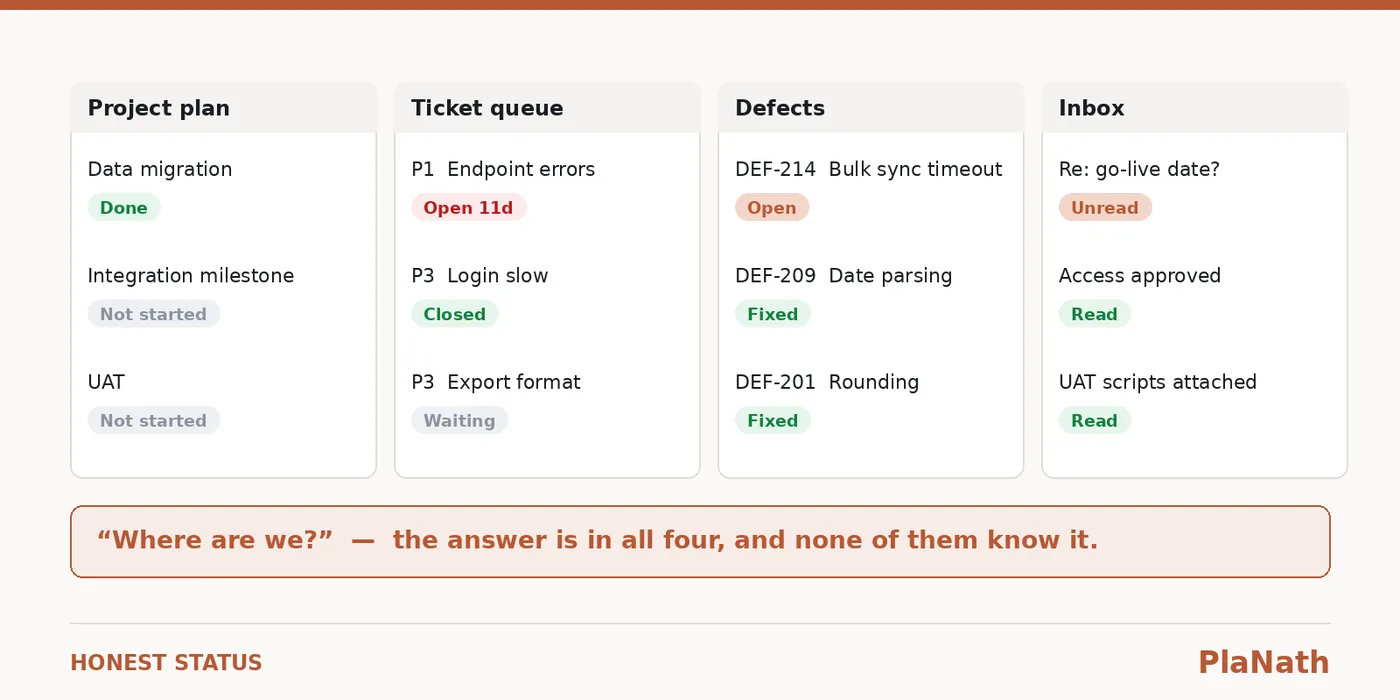
Someone asks where the project stands.
You open the project tool. Then the ticket queue, because there was something about an integration. Then your inbox, to find what the customer said last Thursday. Then a spreadsheet somebody maintains. You message two people. You estimate the rest.
Fifteen minutes later you have an answer that is roughly right and already ageing.
This happens in organisations with excellent people and expensive tools. It is not a discipline problem. It is a structural one.
There are four tabs because the work is in four places
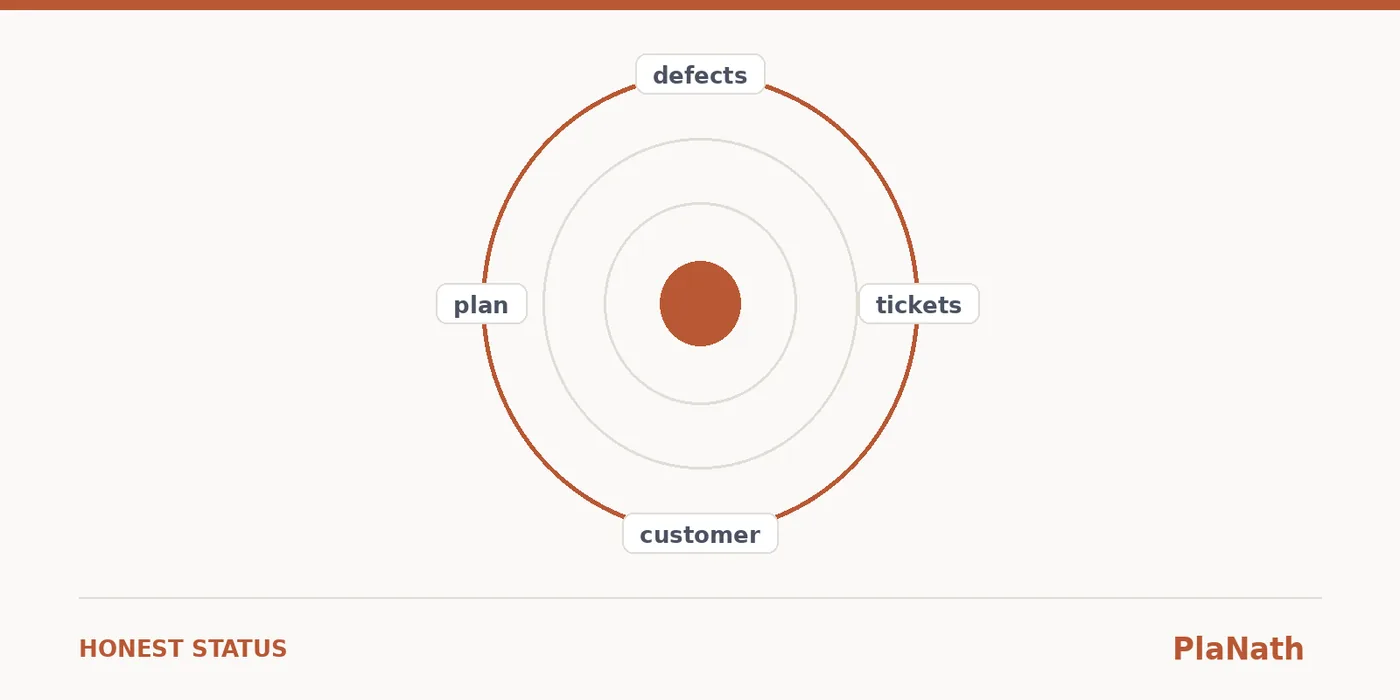
Your plan is in one system. Your tickets are in another. Your defects are in a third. And whatever anyone knows about how the customer is actually feeling is in somebody's head, or in a call recording nobody has listened to.
Each of those tools is good. Each tells the truth about its own contents. And each knows nothing whatsoever about the others.
So the ticket that is holding up a go-live never appears on the plan it is holding up. The escalation that should have changed a project's status never reaches it. The customer who has gone quiet for three weeks looks fine, because "quiet" is not a field in any of them.
The gap is not inside any tool. It is in the space between them, and that space is filled by people remembering to look.
Integration does not close the gap
The usual answer is to connect the tools. Sync the ticket ID onto the task. Pipe alerts into a channel. Build a dashboard that queries three APIs.
This helps, and it is worth doing, but it does not solve the problem — because integration moves data, not meaning. You end up with a ticket reference sitting on a task, which is a link, not a judgement. Nothing in the system knows that this particular open ticket means this particular milestone cannot be called green.
You have also just created a maintenance liability. Every integration is a thing that breaks quietly, usually when someone changes a field name in a tool you do not own.
What "one system" actually buys you
Not fewer logins. Better questions.
When the plan, the tickets, the defects, the escalations and the customer record are in the same system, you can ask things that are simply unavailable when they are apart:
- Which projects have an open P1 against the same customer?
- Which milestones are due in the next two weeks and have an unresolved defect linked to them?
- Which customers have both a slipping plan and a rising ticket volume?
- Which tasks are green and untouched for longer than the reporting cycle?
None of these are exotic. Every delivery lead wants them. They are unavailable not because they are hard, but because the data lives in four places that do not share a definition of "customer".
The honest limitation
Consolidation has a cost, and it is worth naming.
If your engineering team lives in a dedicated issue tracker and will not move, you are not going to win that argument with a slide. Developer tooling is sticky for good reasons. The realistic shape for most services organisations is that the delivery, support and customer-success side consolidates, and engineering keeps its own tracker with a link between them.
That is fine. The gap that hurts is not between two engineering tools. It is between the customer's plan and the customer's problems — and those almost never sit in the same place today.
Where PlaNath fits
PlaNath holds the flagship path in one system: customer → project and workplan → defect management → customer success. Tickets, escalations and the knowledge base sit alongside it, against the same customer record.
That is not a longer feature list. It is the only condition under which anything can answer the question honestly. You answer for the plan. PlaNath answers for the picture — and it can, because nothing about the customer is somewhere else.
PlaNath puts customer, project, tickets and defects in one system. planath.com
Start free trial