Implementation
The handoff nobody owns
Sales to delivery to customer success. Two transitions, and most of the damage in the customer lifecycle happens at them.
4 min read
A customer's experience of you is continuous. Your organisation's experience of them is not: it is three teams, two handoffs, and a quantity of context that survives neither.
What is lost at each one
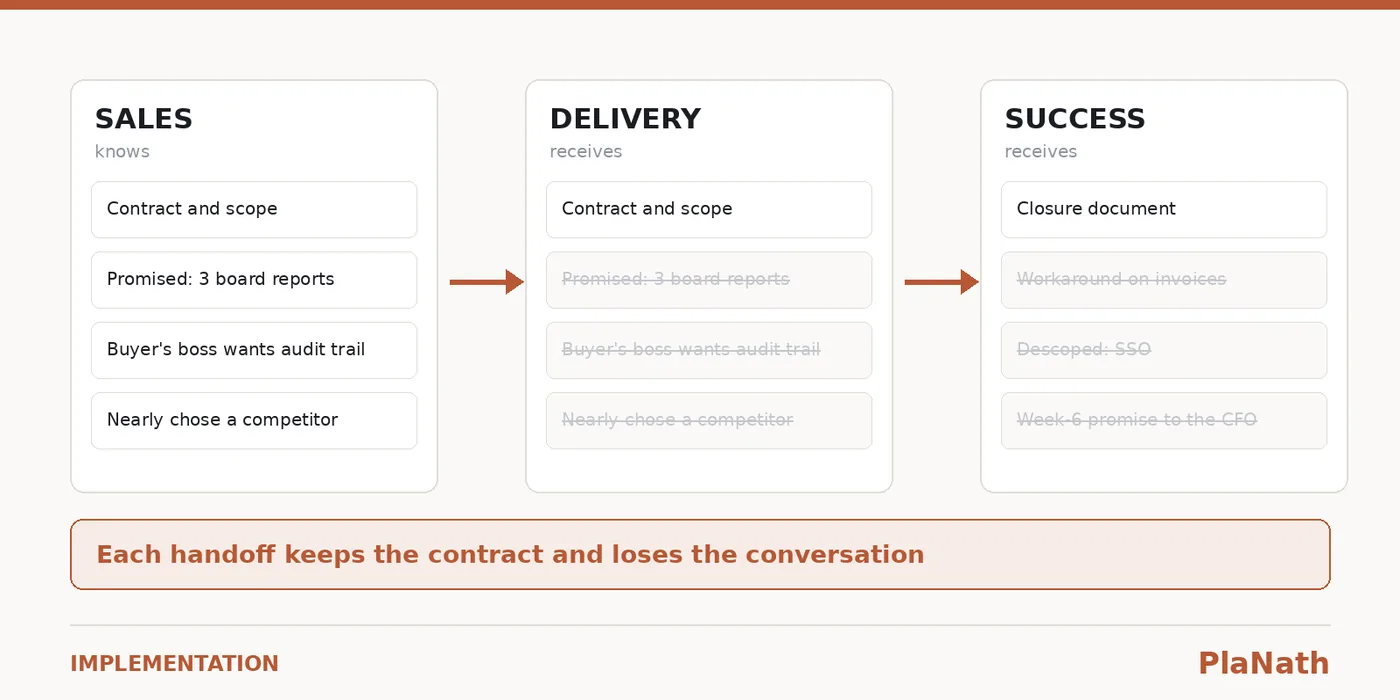
Sales to delivery. What crosses: the contract, the scope document, a handover call. What does not: the specific promise made in the room, the buyer's political situation, the thing their boss actually cares about, the competitor they nearly chose instead, and the three concerns they raised that were answered verbally.
Delivery to customer success. What crosses: a closure document and, if you are fortunate, a call. What does not: which stakeholder was difficult and why, which workaround is holding something together, what was descoped and how the customer felt about it, and which commitment you made in week six to get through a bad moment.
Both handoffs lose the same category of thing: the informal record. And the informal record is where all the risk lives, because the formal record is by definition the part everyone already agrees on.
Why the fix is not a better template
Every organisation that notices this problem responds by building a handover template. It helps a little, then decays, for two reasons.
The first is that filling it in is work for the person leaving the relationship, and the benefit accrues to the person arriving. That incentive gap is fatal over time. The template gets shorter each quarter until it is a formality.
The second is that a template captures what the outgoing person thinks is important, at one moment. The thing that turns out to matter in month four is usually something they did not think worth recording in month one.
What actually works: continuity of record
The alternative is to stop treating handoffs as events where information is transferred, and start treating them as changes of ownership over a record that already exists.
If the customer record, the deal commitments, the project, the workplan, the defects, the tickets and the escalations all live against the same customer in the same system, then nothing has to cross at a handoff. The incoming person inherits the whole history rather than a summary of it.
The difference in practice: instead of reading a handover document that says "customer was frustrated about the reporting delay", they can see the escalation, when it was raised, what was promised, who promised it, and what happened afterwards. That is not the same information. It is better, and it required nobody to write it down.
The three questions a handoff should be able to answer instantly
- What did we promise that is not in the contract? Commitments made in calls, on escalations, in status meetings. If these live as items against the customer rather than in someone's memory, they survive the transition.
- What is currently broken for them? Open defects, open tickets, anything escalated. This should not require asking a colleague.
- What do they think of us? Not a guess — the record of escalations, response times, and how recently anyone spoke to them.
If your current setup cannot answer all three in under a minute, your handoffs are running on memory, and memory leaves the company when people do.
Where PlaNath fits
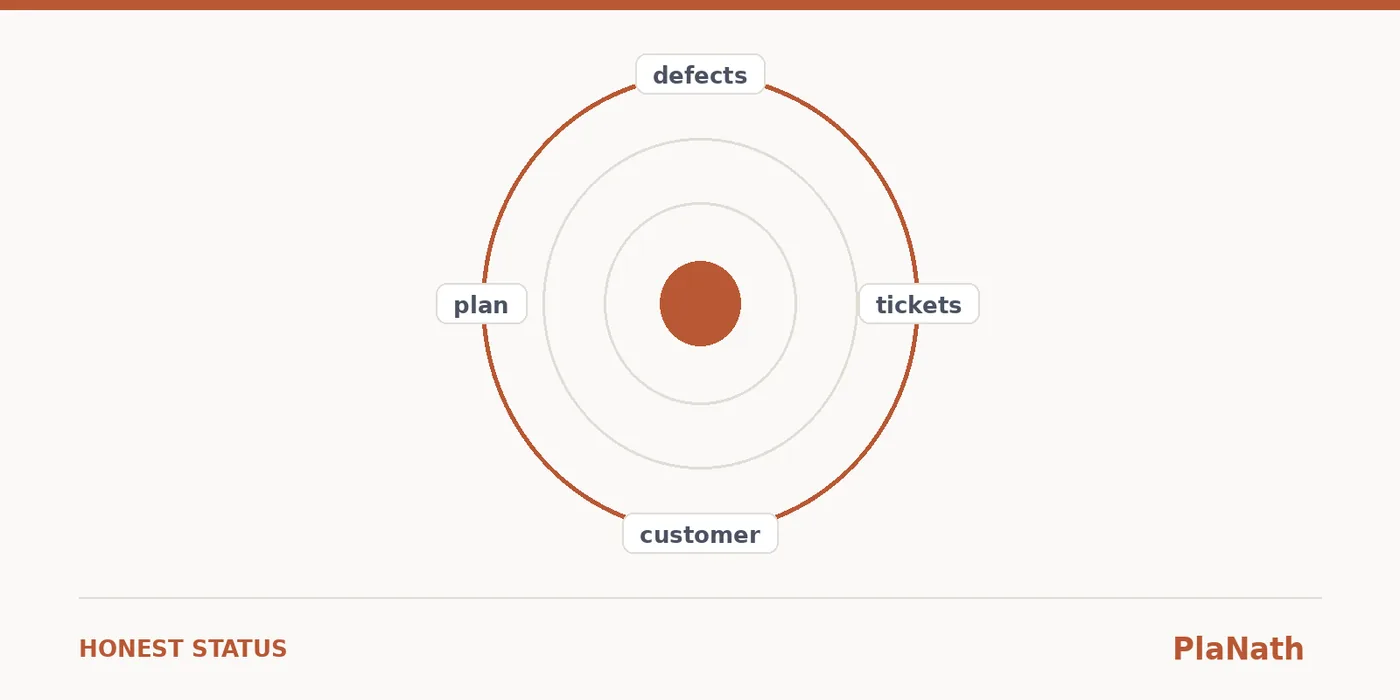
PlaNath's core path is deliberately a single chain: customer → project and workplan → defect management → customer success handoff. The handoff is not a document produced at the end. It is a change of owner on a record that has been accumulating since the customer existed.
That does not make the transition free. Someone still has to have the conversation. But they have it looking at the same screen, which is a different conversation entirely.
In PlaNath the handoff is a change of owner, not a document. planath.com
Start free trial