Choosing tools
Spreadsheets are not the problem
The copy-paste between them is. A defence of the spreadsheet, and a diagnosis of when to stop.
3 min read
Every project tool's marketing implies that spreadsheets are the enemy. They are not. They are the most successful end-user programming environment ever built, and most teams should stay on them longer than vendors would like.
A spreadsheet is instantly available, universally understood, infinitely flexible, free at the margin, and requires no permission from anyone. Against those properties, most software loses on day one.
What spreadsheets are genuinely good at
Shaping a process you do not understand yet. When you are running your fifth implementation and still learning what your method is, a spreadsheet lets you change the model daily. A configured tool makes that expensive, and the cost is paid in a process that hardens before it is right.
They are also honest about being a snapshot. Nobody believes a spreadsheet is live. That sounds like a weakness; it prevents a specific failure, which is trusting a dashboard that has quietly stopped reflecting reality.
The four signals you have outgrown yours
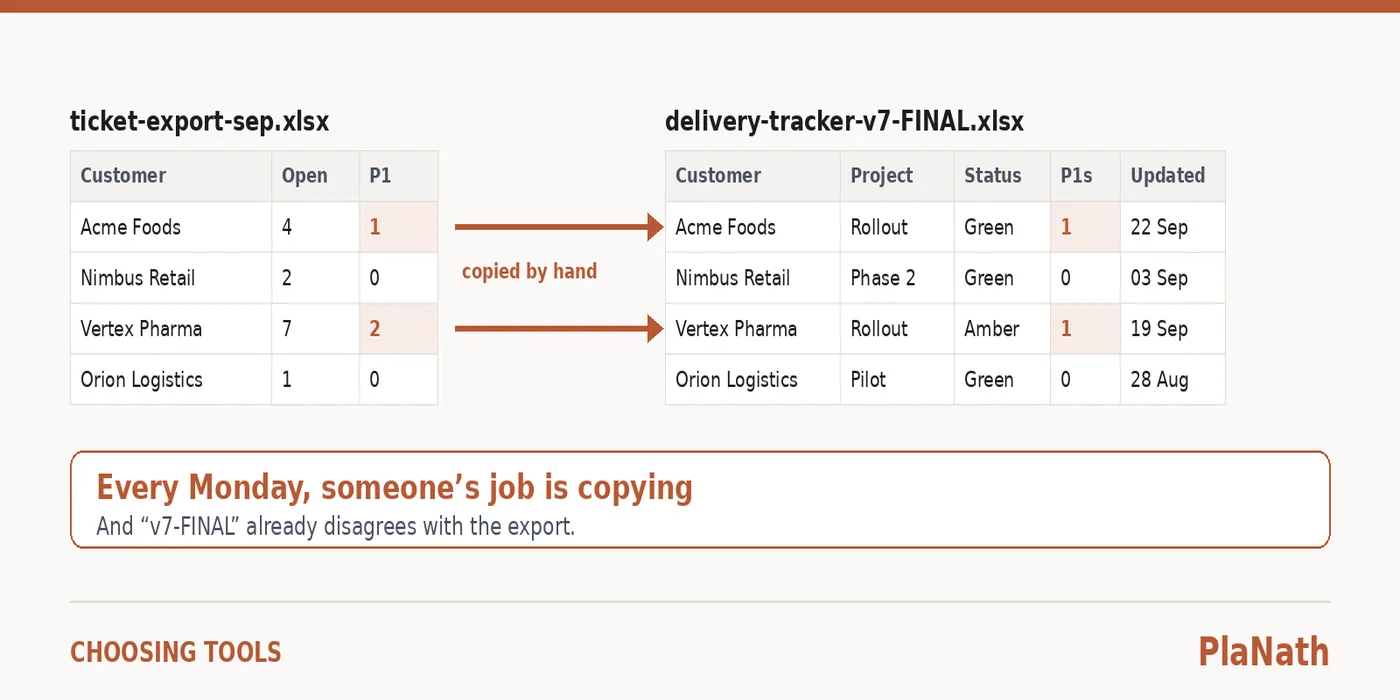
Somebody's job is now copying. When a person spends a recurring block of time each week moving data between the ticket export, the project tracker and the customer list, you are paying a salary to be an integration layer. This is the clearest signal and the most commonly ignored, because the copying is spread across several people in small amounts.
Version questions. "Is this the latest?" appearing in a thread means the sheet has become a document rather than a system. A single shared cloud sheet delays this but does not remove it, because the copies multiply as soon as someone needs to model an option.
Two people give different answers. The head of delivery says eleven projects are active. The account team says nine. Both are reading from spreadsheets, both are correct according to their own, and nobody can say which is right without a reconciliation. Once this has happened twice, the data has forked.
History is gone. Spreadsheets overwrite. When you ask why a date moved, or who changed the status and when, the answer is not there. For a services business this becomes important the first time a customer disputes a commitment.
The honest sequence
Most teams should go: spreadsheet → shared cloud spreadsheet with discipline → structured tool for the part that hurts most → consolidated system.
Skipping to the end is a common and expensive mistake. It buys complexity before the process is stable, and the resulting configuration encodes a method you were still working out.
The right moment to consolidate is when the copying has a cost you can name, and the process has stopped changing weekly.
What consolidation should actually fix
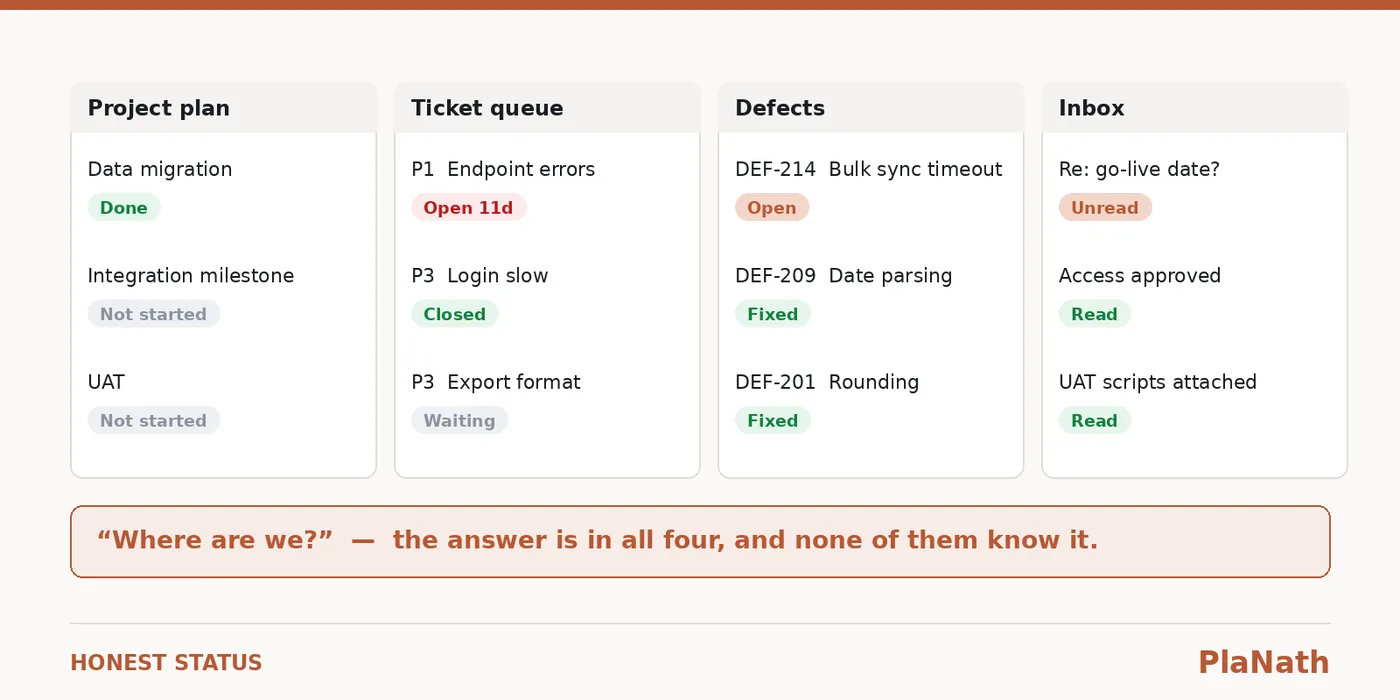
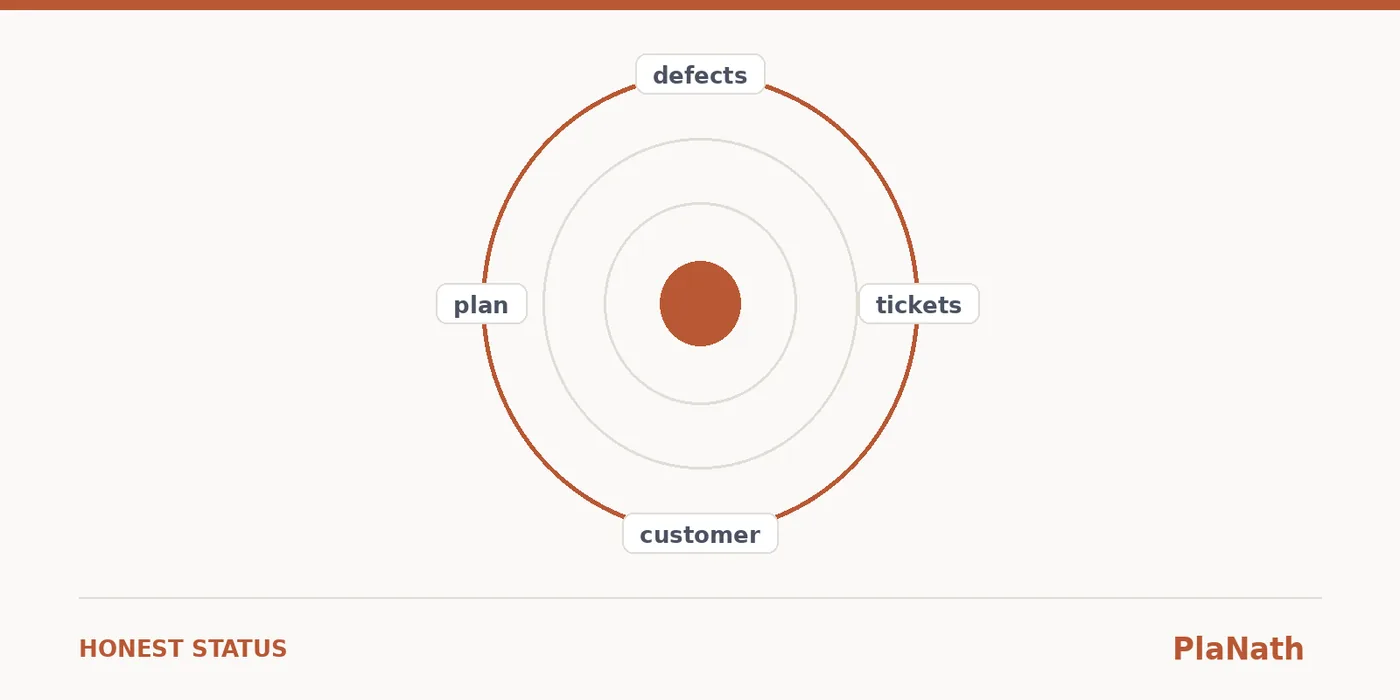
Not tidiness. The specific thing worth paying for is that the customer, their projects, their tickets, their defects and their health stop being separate records that a human has to join.
That is the only reason to leave a spreadsheet that survives scrutiny. If a tool gives you nicer views of the same disconnected data, you have bought a subscription and kept the problem.
PlaNath exists for that specific transition: the point where a services team is running enough customers that the copying between systems has become someone's job. Not before. If you are running four implementations a year, keep your spreadsheet — it is genuinely serving you well.
PlaNath is for the point where copying between systems became someone's job. planath.com
Start free trial