Implementation
From three months to two weeks
What actually changes when you standardise delivery — and the two things that do not.
5 min read
Every services organisation believes its implementations are bespoke. Most are wrong, and the belief is expensive.
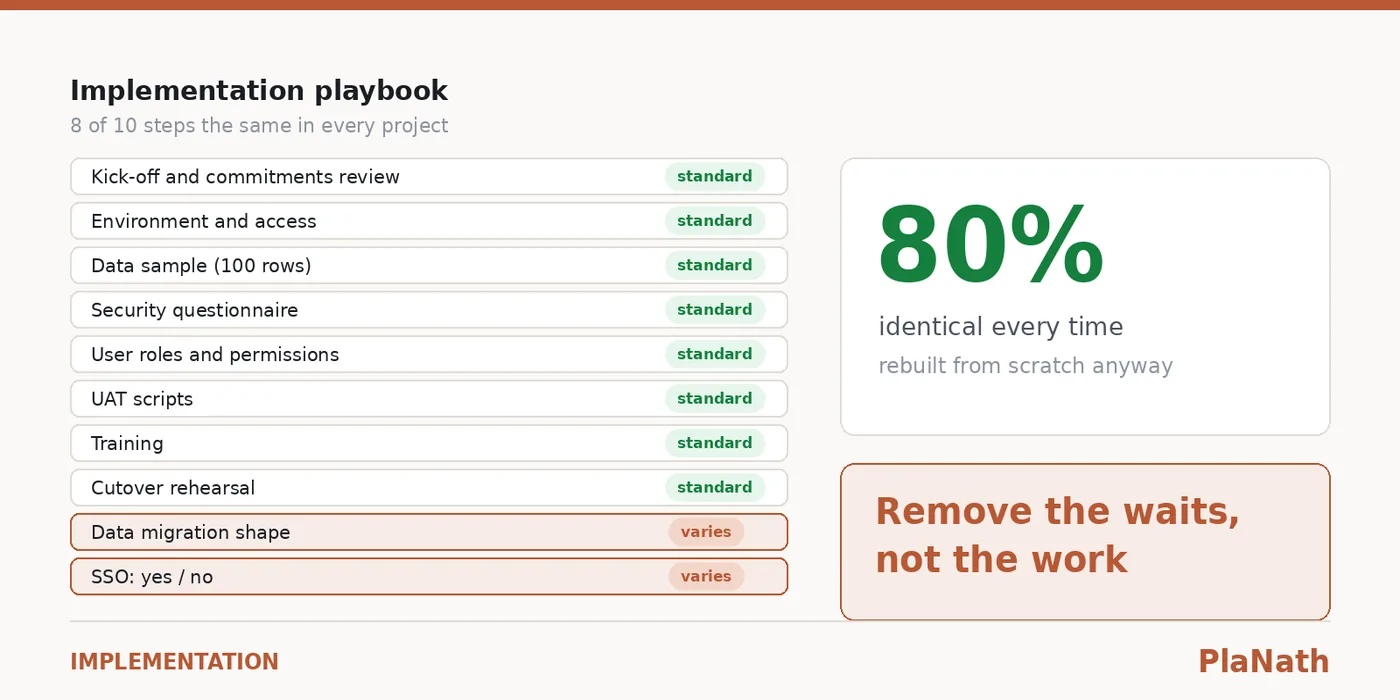
I have run this exercise more than once: take your last ten implementations, list every task, and line them up side by side. What you find is that roughly four fifths of the work is identical in all ten, and appears in a different order, with different names, in each.
That duplication is not skill. It is re-invention, and it is where the elapsed time goes.
Elapsed time is not effort
This is the distinction that makes standardisation worth doing.
An implementation that takes three months usually contains two or three weeks of actual work. The rest is waiting: for an answer, for an environment, for a person who is on leave, for a decision nobody realised was needed until it blocked something.
Working faster does almost nothing to that. Removing the waits does everything.
Standardisation attacks waits, not effort. When the playbook already knows that step nine requires a security questionnaire, you ask for it in week one instead of discovering it in week six. That single reordering can remove a fortnight, and nobody worked any harder.
What a real playbook contains
Not a checklist. A checklist tells you what to do; a playbook tells you what has to be true before you can.
- The standard workplan, with the 80% that repeats, in sequence, with owners by role rather than name.
- Named variation points — the specific places where customers legitimately differ (data migration shape, SSO or not, how many environments) with a pre-agreed option set rather than an open conversation.
- Entry conditions per phase. What must exist before the phase starts. This is the part that removes waits, because it forces the ask earlier.
- The question list, asked once. Every piece of information you need from the customer, collected in a single structured pass rather than dripped out over six weeks. Customers forgive one long form. They do not forgive being asked the same thing three times by three people.
- A definition of first value — the specific thing the customer will be able to do, and the date.
What standardisation cannot fix
Two things, and pretending otherwise is how playbooks lose credibility with the people who have to use them.
It cannot fix a bad deal. If sales committed to something the product does not do, no playbook recovers that. It will surface the problem earlier, which is genuinely valuable, but earlier bad news is still bad news.
It cannot fix a customer who will not engage. The single largest cause of slipped implementations is customer-side availability, and you do not control it. What a playbook does is make the dependency visible and attributable, early, in writing — which changes the conversation from "you are late" to "we are both waiting on this, and it was flagged on the ninth".
That is not a small thing. Most of the damage from a slipped implementation comes from the argument about whose fault it was, not from the delay.
How to build one without a project
You do not need a transformation programme. You need one afternoon and your last ten projects.
- List every task from all ten. Do not tidy them.
- Mark the ones that appear in eight or more. That is your standard workplan.
- For the rest, group them. Most will collapse into three or four variation points.
- Write down what has to be true before each phase starts.
- Run the next implementation against it, and change it afterwards.
Then make it a template in whatever tool you use, so nobody has to remember any of this.
Where PlaNath fits
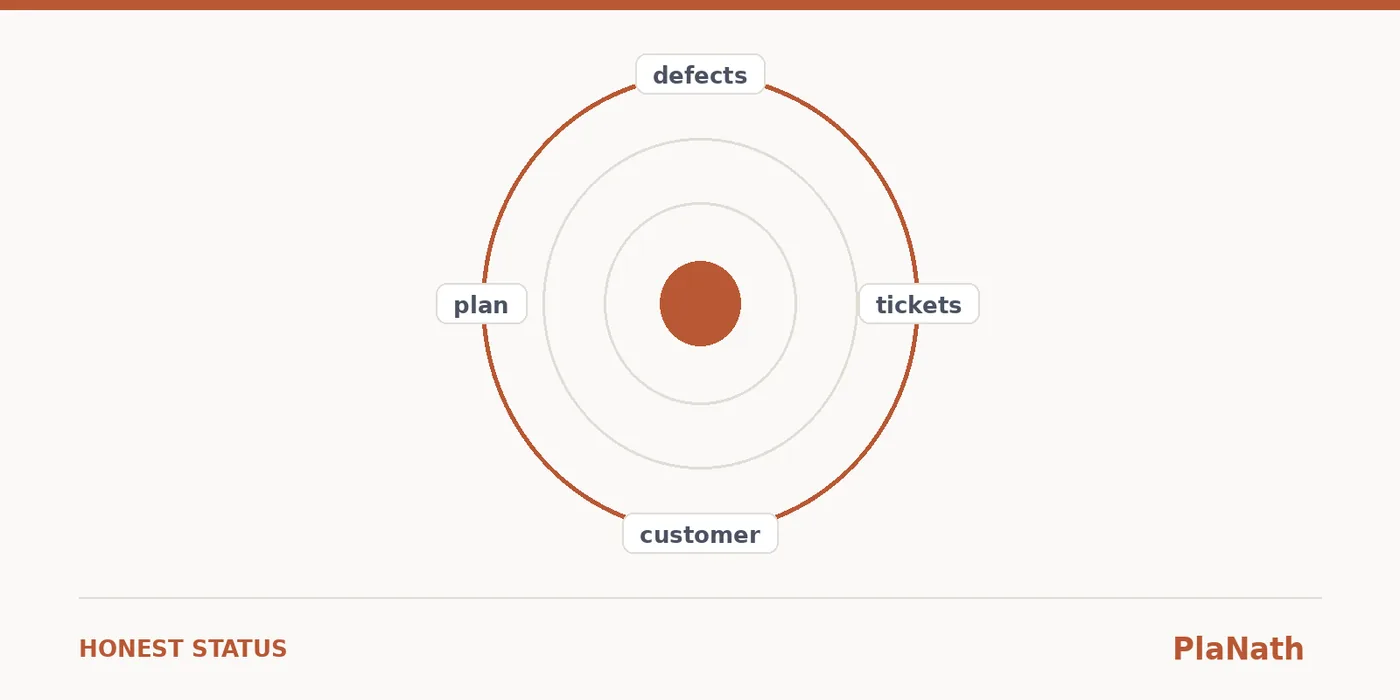
A playbook only holds if the tool makes following it easier than not following it. PlaNath is built around a repeatable path — customer, then project and workplan, then defects, then the customer success handoff — so a standard workplan is the default shape of a new customer rather than something a diligent person remembers to apply.
The organisations that get implementation time down are not the ones with better consultants. They are the ones who stopped solving the same problem eleven times a year.
PlaNath makes the standard workplan the default shape of a new customer. planath.com
Start free trial